
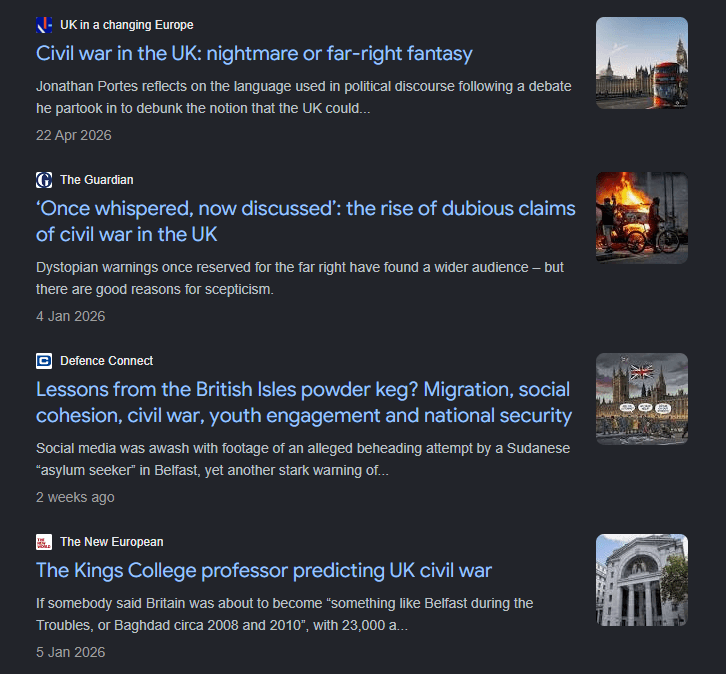
Civil conflict in the UK is no longer a fringe conversation.
Journalists are writing about it. Academics are modelling it. Politicians are being asked about it on camera. The question is no longer whether the UK faces internal instability. It is whether anyone has done the analytical work to understand what that instability would actually look like. We have. We took the methodology we were taught in British Military Intelligence and pointed it inwards. What we found concerns us greatly.
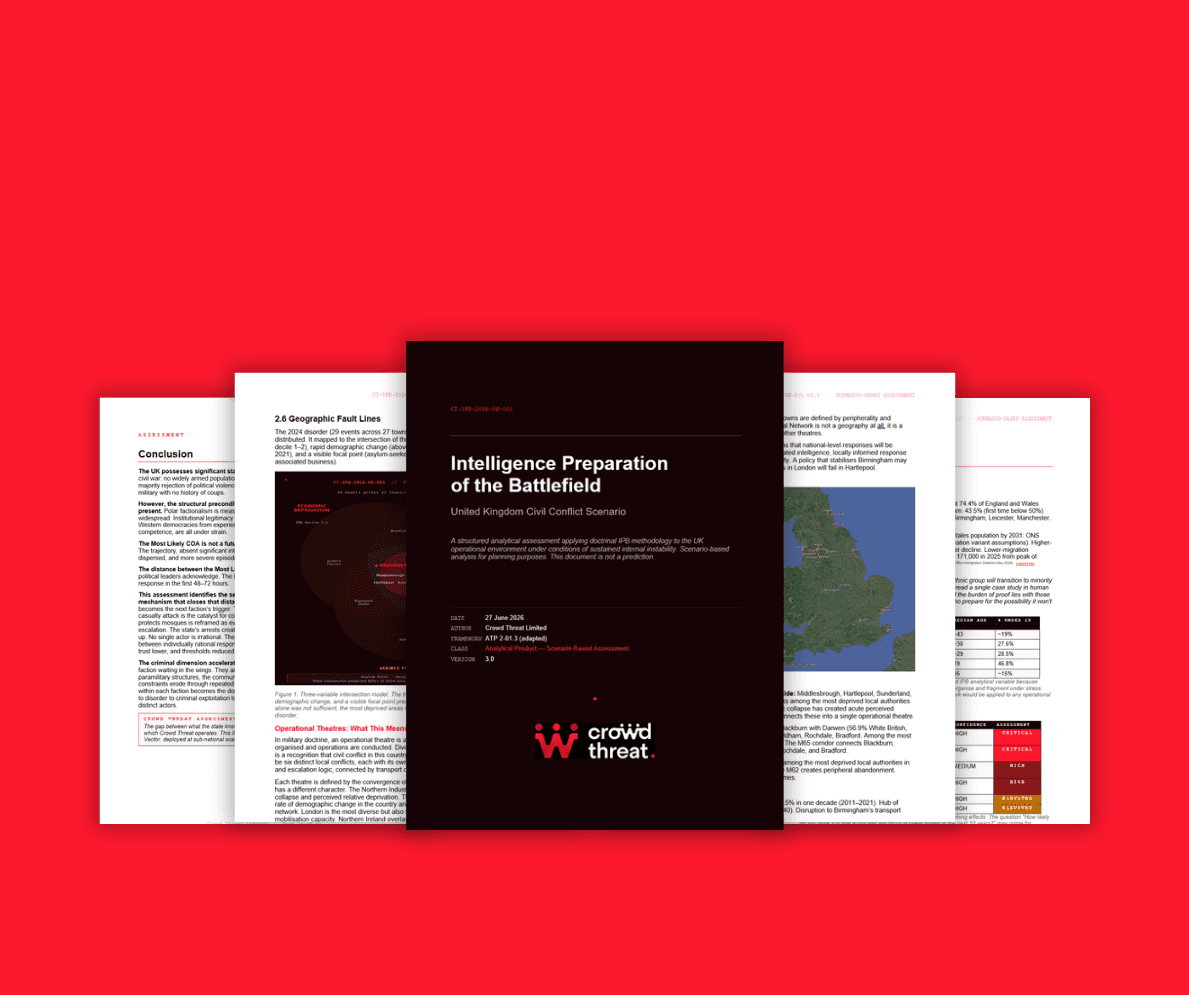
40 pages · v3.0 · PDF
Work email required · No spam · Data not shared
Named locations, transport corridors, and demographic fault lines across the UK.
MLCOA, MDCOA, and three intermediate escalation pathways with probability estimates.
2024 disorder sites cross-referenced against deprivation and demographic data.
40 pages. Four-step doctrinal IPB.
Everything the state should have produced.

You have read about the risk. Now read the assessment no one else has written.
40 pages of doctrinal military analysis applied to your operating environment. Named locations. Named factions. Probability-weighted scenarios. The intelligence product your board, your underwriters, or your command chain should already have on the desk.
Work email required · No spam · Data not shared

The desk analysis tells you the powder is dry. The crowd tells you who is holding the match.
Every intelligence gap identified in this IPB maps to a Crowd Survey collection requirement. No persistent sub-national community sentiment monitoring capability exists in UK government. This product is designed to fill that gap.
The Stability Vector aggregates seven leading indicators from a verified network of local reporters into a forward-looking stability score. It tracks the conditions that precede instability rather than describing instability after the fact.
Learn more about Crowd SurveyConfidence in police, courts, local government, and national institutions. When trust falls below threshold, the state loses its monopoly on legitimacy.
Employment stability, cost of living pressure, perception of opportunity. The fuel for perceived relative deprivation that drives nativist mobilisation.
Inter-community contact frequency, integration indicators, segregation patterns. The binding agent that prevents factional polarisation.
Perceived safety, crime exposure, confidence in state protection. When communities feel unprotected, self-defence formations emerge.
Disinformation exposure, media trust, narrative polarisation. The domain where every faction's rational response becomes the next faction's trigger.
Perceived fairness of governance, representation, democratic participation. The variable that determines whether grievances are channelled or weaponised.
Diaspora dynamics, foreign information operations, cross-border transmission. The vectors through which overseas conflicts become domestic flashpoints.

Quick Silver Way
Newcastle Upon Tyne
NE27 0QQ
United Kingdom