
Ground Truth10
Lebanon Intelligence Summary
CT
Crowd Threat
Intelligence Platform
Over the past week, southern Lebanon has seen a steady drumbeat of Israeli military activity — persistent surveillance drone flights, near-daily strikes on Aali Et Taher Heights in Nabatieh, and a systematic campaign of structure demolitions across Bint Jbeil villages — alongside scattered arson incidents and at least one direct clash with unidentified gunmen. This isn't a one-off spike: it lines up with the unraveling of the US-brokered Iran ceasefire, under which Israel was expected to withdraw from Lebanon but instead stayed on through a separate side arrangement aimed at countering Hezbollah. With that broader deal effectively dead, south Lebanon looks less like a quiet enforcement zone and more like the place where the fallout is actually landing — worth watching closely in the days ahead.
LEBANON
INTELLIGENCE SUMMARY (INTSUM)
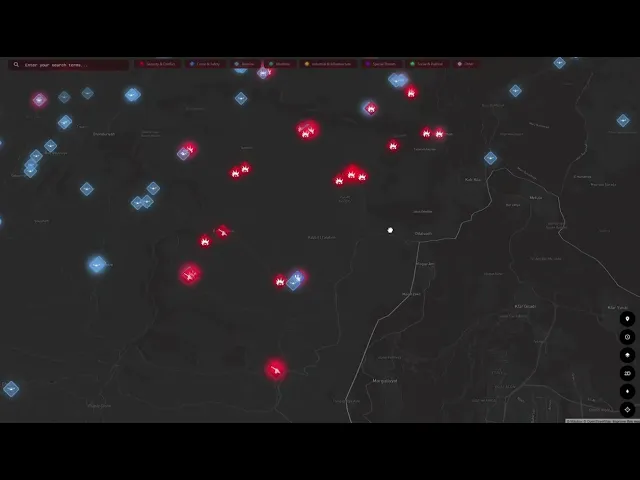
Video - Threats identified in Lebanon on the Crowd Threat platform (past 7 days)
Reporting Period | 27 July 2026 – 3 August 2026 (0000–2359, 3 Aug) |
Issue No. | 2026-31 |
Date of Issue | 3 August 2026 |
Prepared By | Crowd Threat |
Source Basis | Crowd Threat crowdsourced OSINT platform |
Classification | For Website Use |
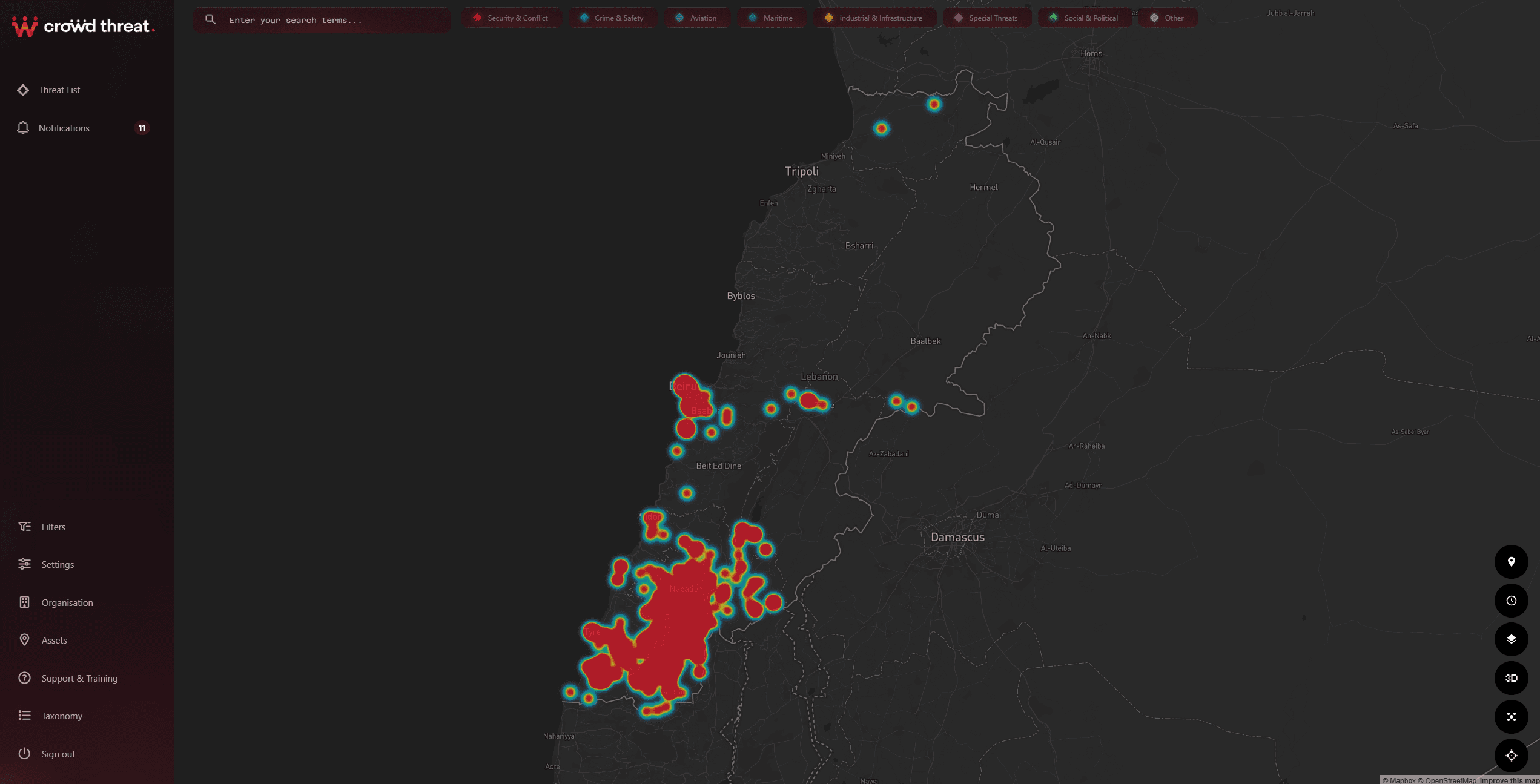
Heatmap - Threats identified on Crowd Threat platform (past 7 days)
1. EXECUTIVE SUMMARY
South Lebanon's border districts — Nabatieh, Bint Jbeil, Marjeyoun, Hasbaya, and Tyre — experienced sustained, low-to-moderate intensity Israeli military activity throughout the reporting period, consistent with an enduring post-ceasefire enforcement posture rather than an acute escalation. Verified reporting was dominated by near-continuous ISR drone surveillance (the single largest category, several hundred verified sightings across the week), a sustained campaign of controlled explosive demolitions of structures in border villages, and recurring artillery and air strikes concentrated overwhelmingly on Aali Et Taher Heights (Nabatieh), which was struck on all but one day of the reporting period.
Beirut and the southern suburbs (Dahieh) saw persistent daily drone overflight activity, indicating continued ISR coverage of Hezbollah-associated neighborhoods well outside the border zone. Two isolated incidents of civil unrest were recorded, both unrelated to the border conflict: a sit-in protest outside Nabatieh's governorate building and a violent depositor protest outside a Beirut bank tied to the ongoing banking crisis.
No single verified incident this period indicates imminent escalation beyond the established pattern of activity. The sustained tempo of demolitions in Bint Jbeil District and repeated strikes on Aali Et Taher Heights are the two trends most warranting continued client attention.
2. KEY DEVELOPMENTS
A. ISR / Drone Surveillance
Verified drone sightings were reported daily and constitute the majority of this week's dataset. Coverage was concentrated over Nabatieh, Bint Jbeil, Marjeyoun and Tyre districts, but also extended consistently to Beirut and Baabda District — including Ras Beirut, Haret Hreik, Bourj el-Barajneh, Ghobeiry and Chyah — indicating sustained ISR interest in Hezbollah-associated areas of the capital, not only the border strip. Additional lower-frequency sightings were recorded over Sidon, Aley, Chouf and the Beqaa Valley (Sohmor, Machgara, Zahlé).
B. Explosive Demolitions / Controlled Detonations
A sustained campaign of “explosive demolition” events was recorded almost daily, heavily concentrated in Hadatha (Bint Jbeil District), with further activity in Kfar Tebnit, Taybeh, Deir Siriane, Tallousa, Bint Jbeil town, Majdel Zoun, Qantara and Beaufort Castle (Arnoun). The village-by-village, structure-by-structure pattern is consistent with a systematic clearance operation targeting suspected Hezbollah infrastructure along the border strip rather than active combat exchanges.
C. Artillery & Air Strikes
Aali Et Taher Heights (Nabatieh) was the most frequently struck location of the period, hit by artillery and/or air strikes on nearly every day from 27 July to 3 August, including two aviation attacks on 2–3 August among the more serious incidents of the week. Additional, less frequent strikes were verified on Nabatiyeh El Faouka, Kfar Remen, Mansouri and Shama (Tyre), and Chebaa (Hasbaya District).
D. Arson & Property Destruction
Reports of Israeli forces setting fire to homes and olive groves were recorded in Yaroun, Markaba, Mansouri, Beit Yahoun and Qantara — a recurring pattern of agricultural and property destruction affecting South Lebanon border communities.
E. Direct Engagements & Military Movement
An armed clash between an IDF Egoz unit and unidentified gunmen was reported near Aali Et Taher (31 July), and a separate clash left an officer injured in Nabatieh. IDF tank and small-arms fire was verified in Mansouri (Tyre). A new Israeli military position was reportedly established at Kfarchouba (Hasbaya District), while the Lebanese Army was reported restricting a Hezbollah resupply route at Rmaich (Bint Jbeil District). An Israeli naval vessel was reported firing on fishing boats off Tyre, and a separate incident saw the IDF report an accidental interceptor missile launch near Aalma ech Chaab.
F. Civil Unrest (non-conflict related)
A sit-in protest was held outside the Nabatieh governorate building (1 August) over local grievances, and a violent depositor protest occurred outside Byblos Bank in Sin el Fil, Beirut (28 July) — both linked to domestic economic and administrative grievances rather than the security situation on the border.
3. GEOGRAPHIC BREAKDOWN

Southern Lebanon - Threats identified on Crowd Threat platform (past 7 days)
District / Area | Dominant Activity | Notable Locations |
Nabatieh District | Persistent drone surveillance; near-daily artillery and air strikes | Aali Et Taher Heights, Nabatiyeh El Faouka, Kfar Remen |
Bint Jbeil District | Sustained explosive demolition campaign; drone surveillance | Hadatha, Kfar Tebnit, Beit Yahoun, Aayta Ej Jabal |
Marjeyoun District | Explosive demolitions; artillery strikes | Taybeh, Deir Siriane, Tallousa, Markaba, Qantara |
Tyre District | Drone surveillance, arson, artillery, maritime incident | Mansouri, Majdel Zoun, Shama |
Hasbaya District | Drone surveillance, artillery, new military position | Chebaa, Kfarchouba |
Beirut / Baabda (Dahieh) | Persistent daily drone overflights | Ras Beirut, Haret Hreik, Bourj el-Barajneh, Ghobeiry, Chyah |
Beqaa / Sidon / Aley / Chouf | Lower-frequency drone surveillance | Sohmor, Machgara, Khalde, Sidon city |
4. FORECAST / OUTLOOK
Absent a change in posture, expect continued daily drone activity and explosive demolitions in Bint Jbeil and Marjeyoun districts at a similar tempo. Aali Et Taher Heights remains the most probable location for further artillery or air strikes given the frequency of targeting this period. Watch for any expansion of the reported new position at Kfarchouba, further friction between the Lebanese Army and Hezbollah around resupply routes near Rmaich, and any recurrence of depositor-driven civil unrest in Beirut tied to the ongoing banking crisis.
5. REGIONAL CONTEXT & DIPLOMATIC BACKDROP
The pattern of Israeli activity documented above in south Lebanon should be read against the collapse of the broader US-brokered Iran ceasefire (the post-Midnight Hammer memorandum of understanding, or MOU), rather than as routine, self-contained enforcement. Reporting from within the US administration indicates the MOU included a provision requiring full Israeli withdrawal from Lebanon. A separate, parallel arrangement negotiated by the US Secretary of State with the Lebanese government reportedly allowed Israeli forces to remain in Lebanon under the stated aim of countering Hezbollah, including a proposed joint monitoring center and a US Central Command role. Israel's continued presence under this side arrangement — rather than withdrawal per the MOU — is cited as a key factor in the wider ceasefire's collapse, alongside Iranian strikes on shipping in the Strait of Hormuz and domestic Iranian political pressure following the killing of the Supreme Leader in the earlier conflict.
Read this way, the sustained tempo of drone surveillance, artillery strikes on Aali Et Taher Heights, and the village-by-village demolition campaign in Bint Jbeil District documented this week are likely the operational expression of this US-tolerated Israeli counter-Hezbollah campaign in Lebanon, not an isolated or temporary spike. The Lebanese Army's reported restriction of a Hezbollah resupply route at Rmaich this week is consistent with Lebanese state cooperation with this arrangement.
Actor incentives relevant to the Lebanon picture:
• Israel: doctrine favors periodic decapitation and destabilization strikes (“mowing the grass”) over occupation or negotiated settlement in Lebanon, Gaza, and Syria; sustained presence in south Lebanon is likely to continue absent a change in the underlying arrangement.
• Iran/Hezbollah: under internal pressure to demonstrate deterrence following the killing of Iran's Supreme Leader; reduced incentive to restrain Hezbollah relative to the period preceding that killing, raising (not lowering) the risk of a Hezbollah-linked response in Lebanon.
• Lebanese government: appears to be cooperating, at least partially, with the US-brokered arrangement targeting Hezbollah logistics, which may create friction with Hezbollah domestically.
• Gulf states: hedging between the US/Israel position and Iran, which may reduce diplomatic pressure on Israel to withdraw from Lebanon in the near term.
Net assessment: any renewed escalation between Iran and Israel/the US (e.g., over Strait of Hormuz shipping) would likely have rapid knock-on effects in south Lebanon given this linkage, and should be treated as a leading indicator for this report going forward.
6. METHODOLOGY & SOURCING
This summary is derived from Crowd Threat's crowdsourced OSINT platform — “local eyes on global threats.” Figures reflect observed dataset volumes for the 27 July – 3 August 2026 reporting window and should be read as indicative of reporting activity and pattern, not as an exhaustive census of all incidents in Lebanon during the period.
Want live access to this kind of ground-truth reporting as it happens? Book a demo of the Crowd Threat platform — real-time, crowd-verified incident tracking; local reporters on the ground in places most feeds can't reach; and confidence-scored alerts so your team can tell signal from noise before it hits the news.
BOOK A DEMO

Contact
contact@crowdthreat.com15A Cobalt Business Park
Quick Silver Way
Newcastle Upon Tyne
NE27 0QQ
United Kingdom
Quick Silver Way
Newcastle Upon Tyne
NE27 0QQ
United Kingdom